Avoid These Activities if You Have Scoliosis
Unnatural spinal curving is called scoliosis, a condition affecting 2-3% of the population. It frequently occurs in people aged 10 to 15 years, though it may affect babies, small children, or seniors. Though no cure exists, braces and surgery may prevent further deformity. Knowing what to avoid with scoliosis also reduces the risk of spinal curve progression.
A possible treatment for scoliosis is core strengthening. It reduces pain while increasing your spine’s stability, though not all exercises are beneficial. A trained physical therapist creates a workout that targets the right areas without causing further damage. They’ll also discuss what not to do, including the activities discussed below.
Avoid Doing These if You Have Scoliosis
Past studies suggest that exercise could increase the lateral curves of scoliosis in some patients. However, recent evidence shows the opposite is true, frequently benefiting those with braces, or who are pre-surgery or post-surgery. Of course, despite these findings, not all activities offer the same advantages, including the following.
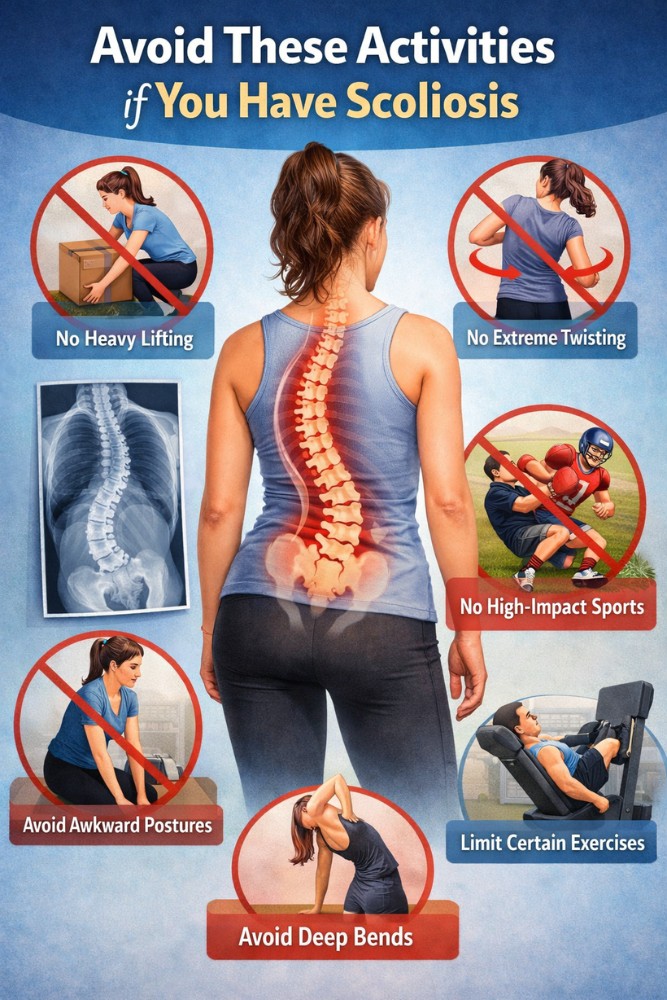
Overusing one side of the body and prolonged awkward postures
According to experts, the curve of the spine in scoliosis causes several symptoms that alter how you move. Your shoulders, hips, and waist may become uneven, with one side higher than the other. The head is often off-center, and the entire body may even lean to one side.
However, it isn’t only your awkward posture that’s affected by the unnatural curvature. The altered alignment also affects the back muscles surrounding the spine. Evidence shows imbalances in those muscles. Those on the inner curve increase support, becoming stronger, while the outer curve weakens from lack of use.
To correct this scoliosis issue, avoid uneven loading, especially when lifting heavy items. The more often you overload the stronger side, the worse the imbalance becomes.
Extreme twisting
Movement and exercise often benefit scoliosis, particularly in the early stages. However, as the condition progresses and the spine’s curve becomes more pronounced, its inflexibility increases. A rigid spine doesn’t move as well as it should, often causing further damage and injury if you’re not careful.
It’s best to avoid hyperextension and unnatural arching with scoliosis. Though many scoliosis-specific exercises slow or halt the condition’s progression, extreme twisting may increase vertebrae rotations. This may increase the curve instead of correcting it.
Sharp bends or twists should also be avoided after spinal fusion surgery to correct the curve, according to experts. These movements could damage the hardware used to straighten the spine, requiring future stabilizing surgeries.
High-impact physical activities
Physical activity, including walking, cycling, and swimming, increases core strength and improves scoliosis symptoms. However, not all exercises offer those same benefits. In fact, it’s believed that high-impact sports could aggravate your condition.
For instance, football and other contact sports risk injuring your spine and back. Gymnastics requires extreme bends, which could also damage the area and worsen scoliosis. Weight machines, such as shoulder or leg presses and abdominal machines, increase spinal pressure and should be avoided with scoliosis.
Though not high impact, some stretching exercises or yoga poses may also worsen scoliosis. It’s best to stick with core-building poses while avoiding those that bend your back and ribs or twist your torso. Instead, stick with those gentle stretches that improve strength, such as cat/cow, mountain, or tree poses.
Resources:
- PMC, March 2009, Is physical activity contraindicated for individuals with scoliosis? A systematic literature review
https://pmc.ncbi.nlm.nih.gov/articles/PMC2697577/ - AANS, April 30, 2024, Scoliosis
https://www.aans.org/patients/conditions-treatments/scoliosis/ - Clear Scoliosis Institute, Scoliosis Muscle Imbalance: Symptoms and Treatment Options
https://clear-institute.org/blog/scoliosis-muscle-imbalance/ - Clear Scoliosis Institute, Can Scoliosis Be Corrected With Exercise?
https://clear-institute.org/blog/can-scoliosis-be-corrected-with-exercise/ - PeaceHealth, Spinal Fusion for Scoliosis
https://www.peacehealth.org/medical-topics/id/hw62352 - Scoliosis Support & Research, Feb. 19, 2025, Which Exercises Should I Avoid If I Have Scoliosis
https://ssr.org.uk/2025/02/19/which-exercises-should-i-avoid/ - Cleveland Clinic Sept. 30, 2021, What to Keep in Mind While Doing Yoga with Scoliosis
https://health.clevelandclinic.org/yoga-for-scoliosis
This article contains informational and educational materials and does not replace health or medical advice. For questions or concerns regarding your medical condition or health objectives, speak to a qualified physician or healthcare provider.
Leave A Comment